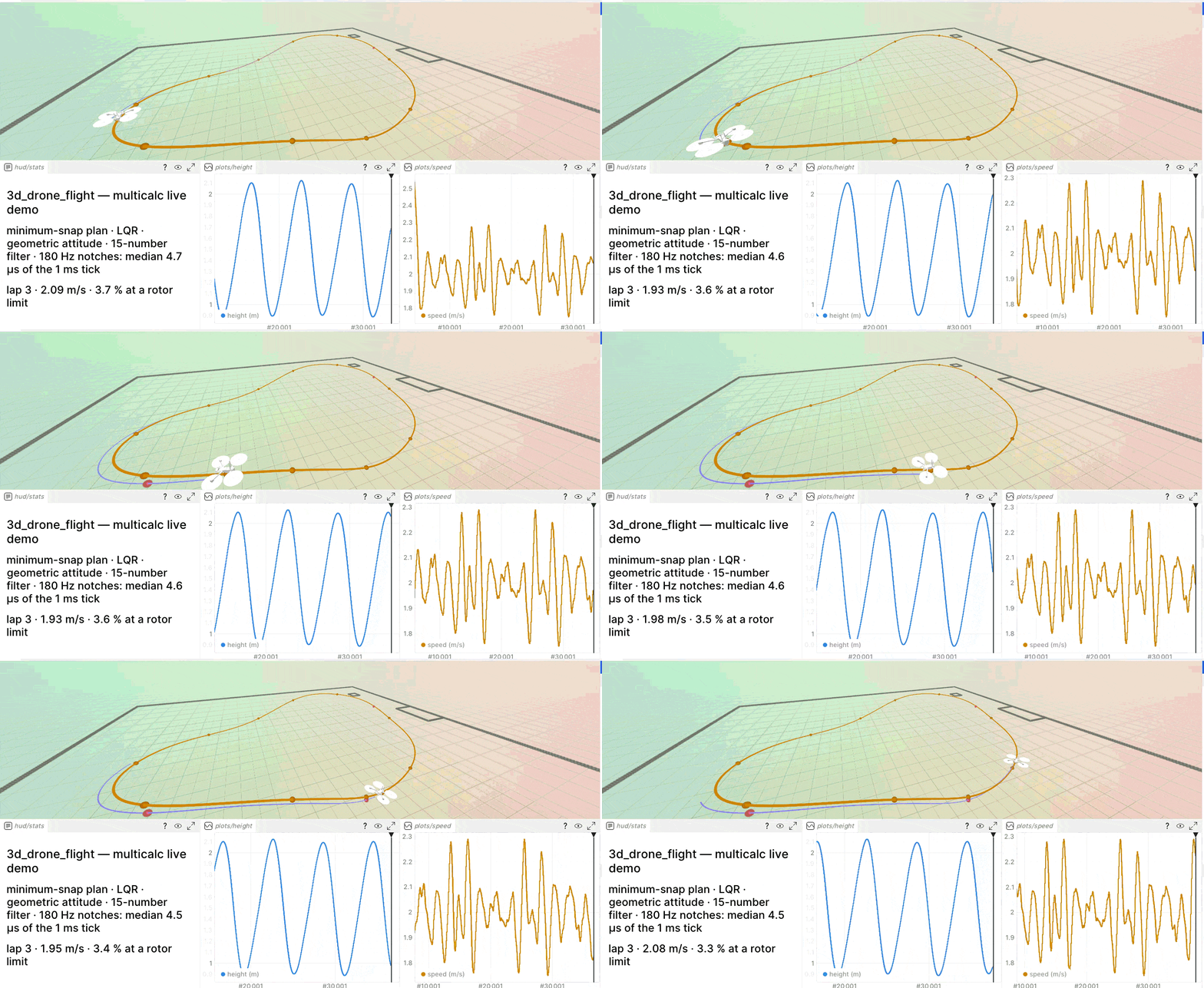
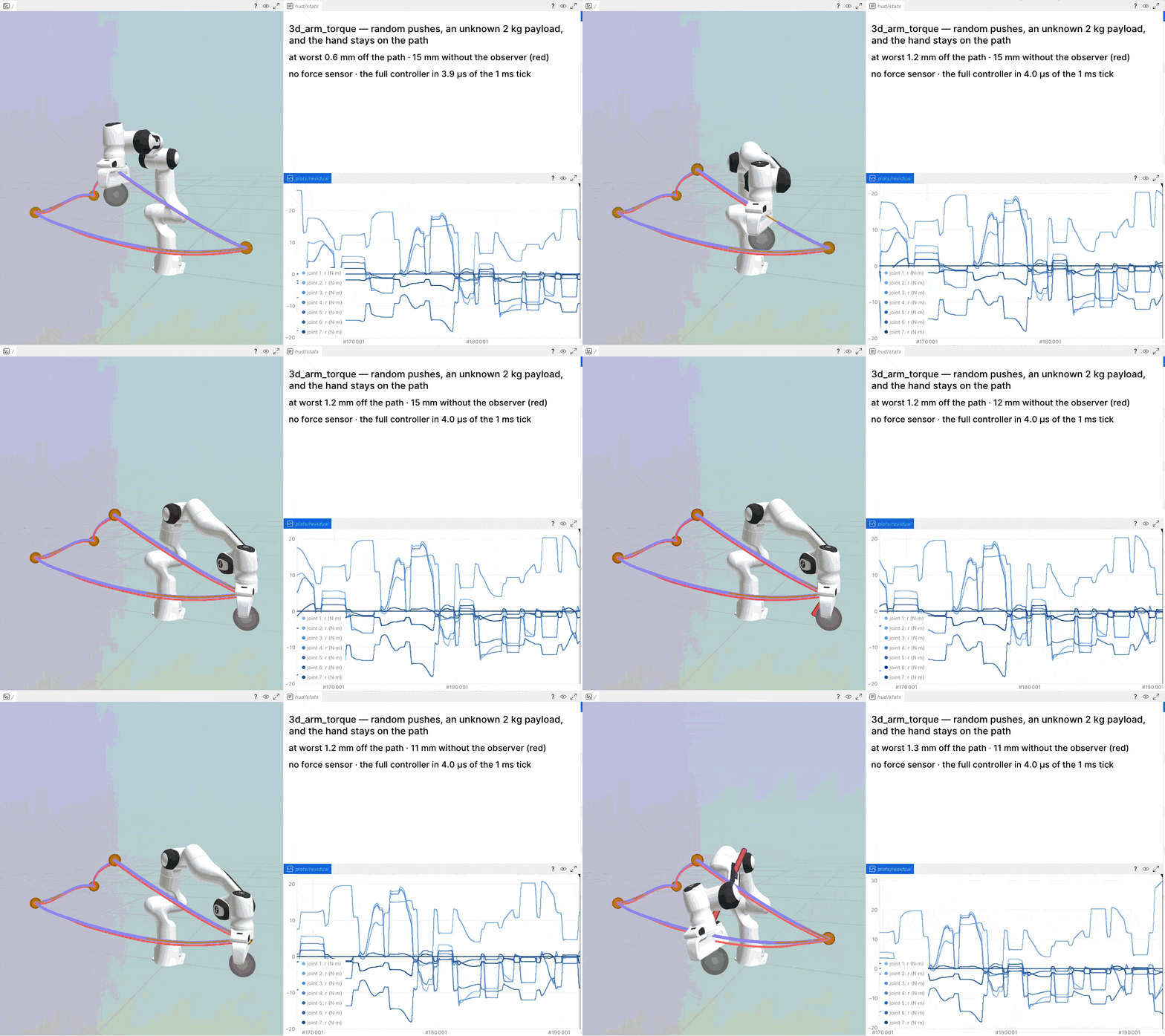
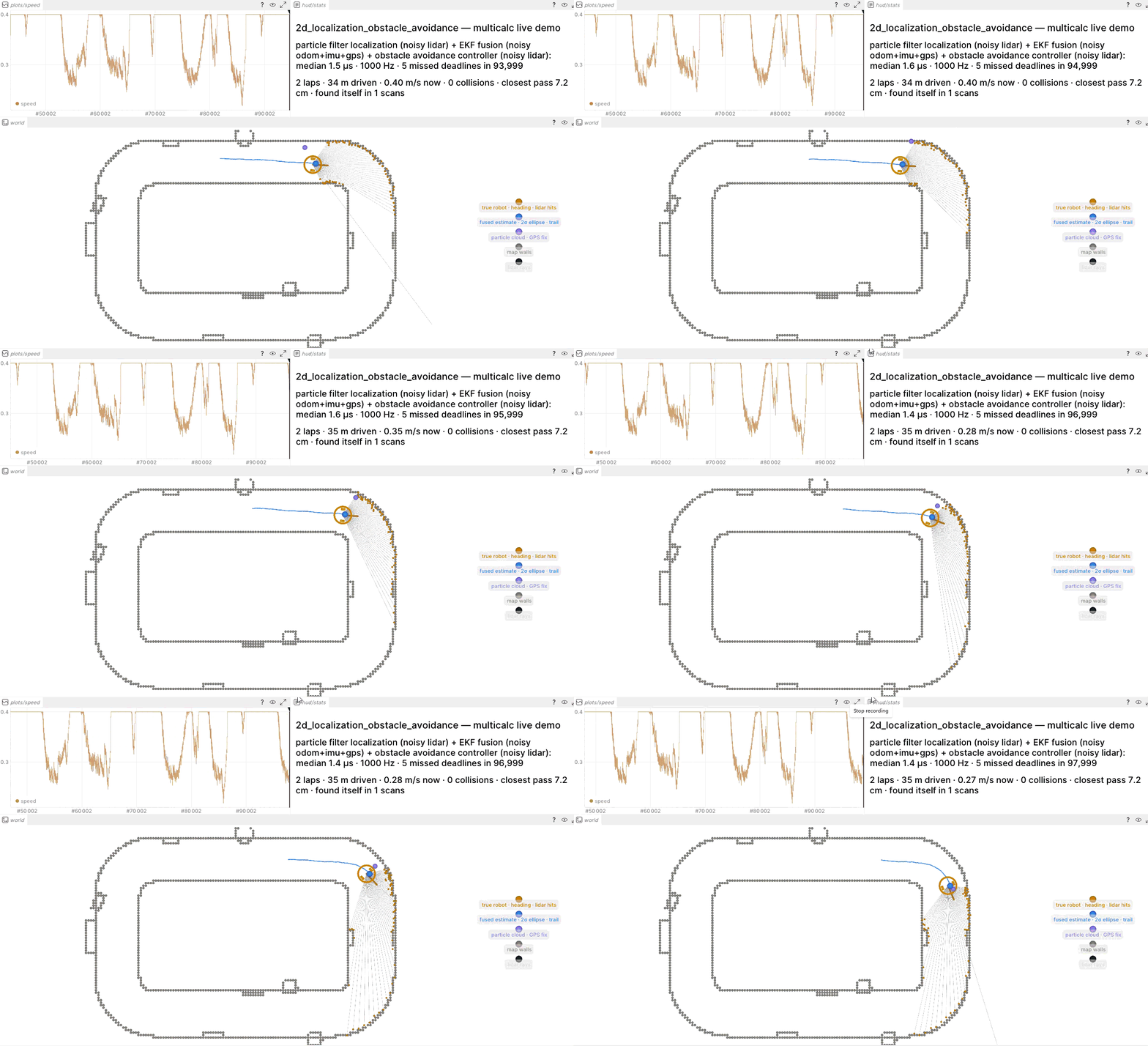
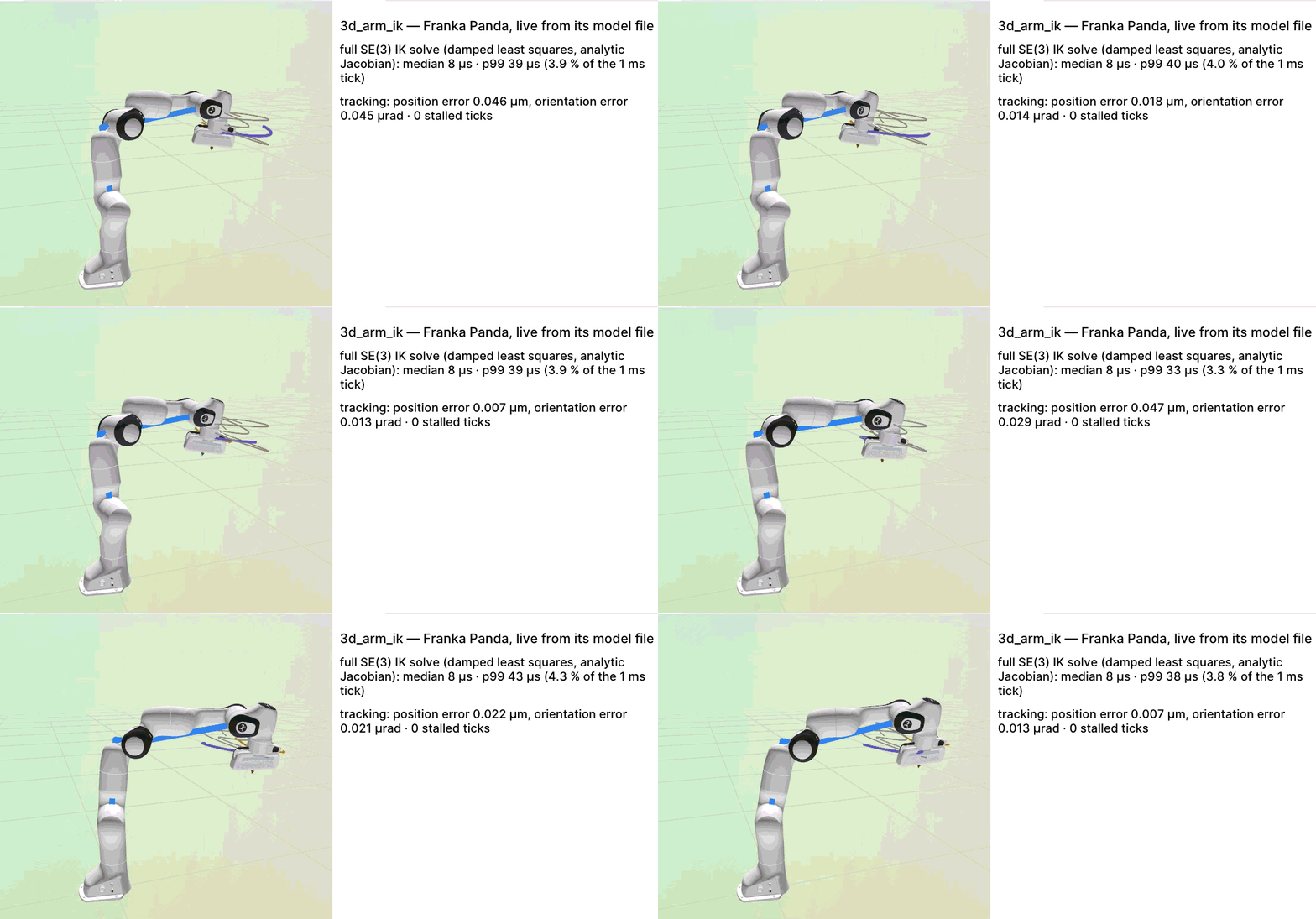
Every number on screen is measured live.
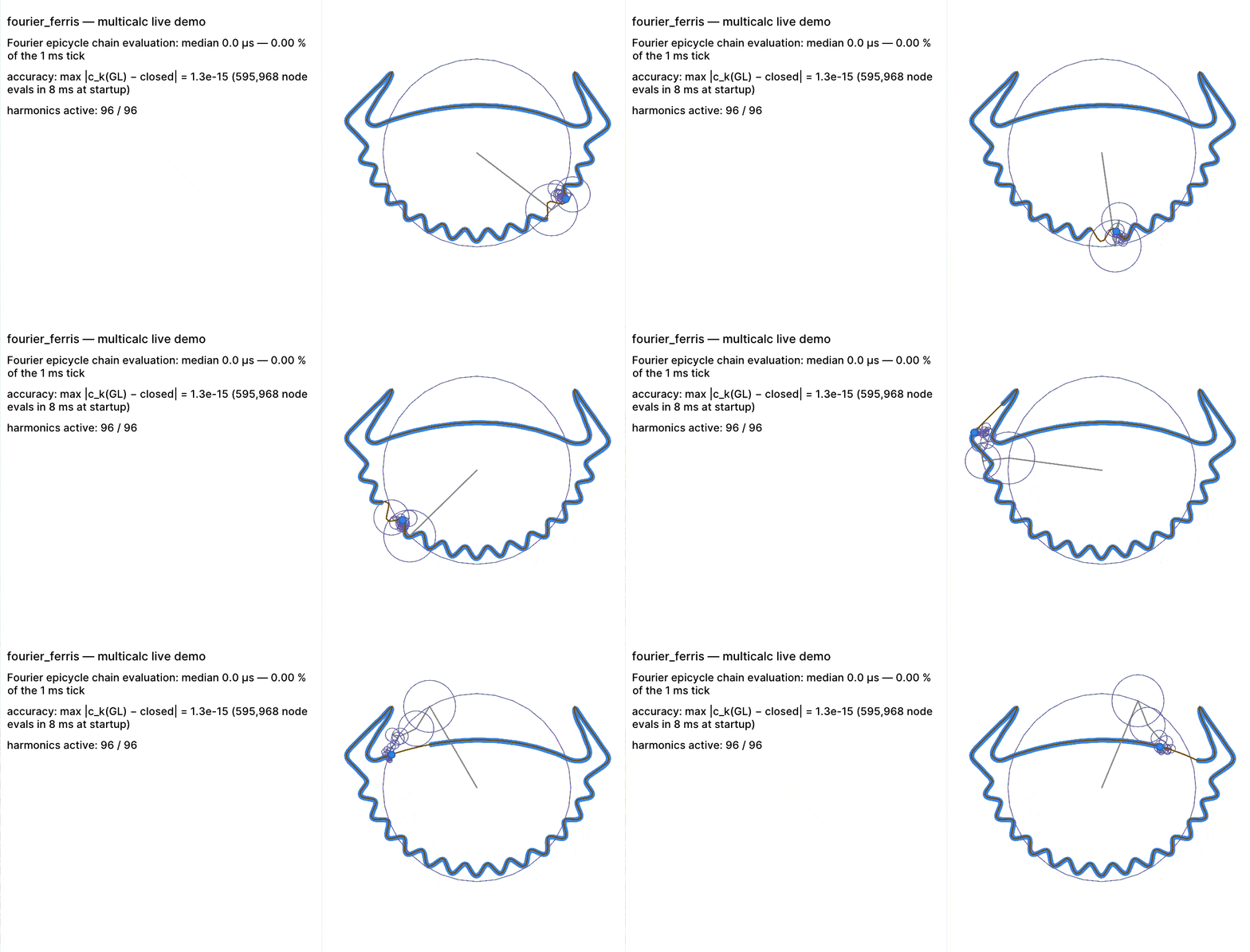
Rerun showcases. Each tick is one fixed 1 ms step. Open a recording in the browser, or run the source on your machine.
Same math. Real chips. Timed in cycles.
Microseconds on three microcontrollers, Arm and RISC-V. Nanoseconds on a desktop.
Warm time per check
Log scale. Best of seven runs. Each run checks each answer against a golden or an identity. f32 runs on the FPU of the Arm boards and in software on the XIAO. f64 runs in software on each board.
Time per call
Log scale. Criterion median, x86_64 i7-12650H, release profile.
Host. Emulator. Silicon.
183 checks against NumPy/LAPACK, SciPy/MINPACK, Pinocchio, mpmath, MuJoCo, mink and FilterPy. Golden floats stored bit-exact. CI fails on any drift.
| Platform | Core | Runs on | Gate | .text, KB | Peak stack, B |
|---|---|---|---|---|---|
| x86_64-unknown-linux-gnu | x86_64 | CI host | full test suite | – | – |
| aarch64-unknown-linux-gnu | Arm64 | CI host | full test suite | – | – |
| thumbv7em-none-eabihf | Cortex-M4F | QEMU | goldens · cross-ABI | 200.8 | 3,631 |
| thumbv7em-none-eabi | Cortex-M4, soft-float | QEMU | goldens · cross-ABI | 166.5 | 3,311 |
| riscv32imc-unknown-none-elf | RV32IMC | QEMU | goldens | 196.4 | 3,291 |
| thumbv6m-none-eabi | Cortex-M0 | QEMU | canary set | 43.5 | 908 |
| Nucleo-F411RE | Arm Cortex-M4F | silicon | goldens · µs budget | – | – |
| Pico 2 | Arm Cortex-M33 | silicon | goldens · µs budget | – | – |
| XIAO ESP32-C3 | RISC-V RV32IMC | silicon | goldens · µs budget | – | – |
Host and QEMU run in CI. Silicon runs on real boards. .text and peak stack are for the release smoke binary at f64; a PR fails at +10%.
The robot apps on silicon need more. On the Nucleo-F411RE: arm 31 KB of stack and 159 KB of flash, drone 8 KB and 97 KB, mobile_and_policy 2.7 KB and 150 KB. The Dual and f64 Franka frames set the arm stack. No app uses a heap.
One integrated stack.
Each module has a tutorial, a demo and a fixture table.
Built on its own no_std math core.
Autodiff, linear algebra and solvers. You can also use the core alone.
Write it once. Differentiate it exactly.
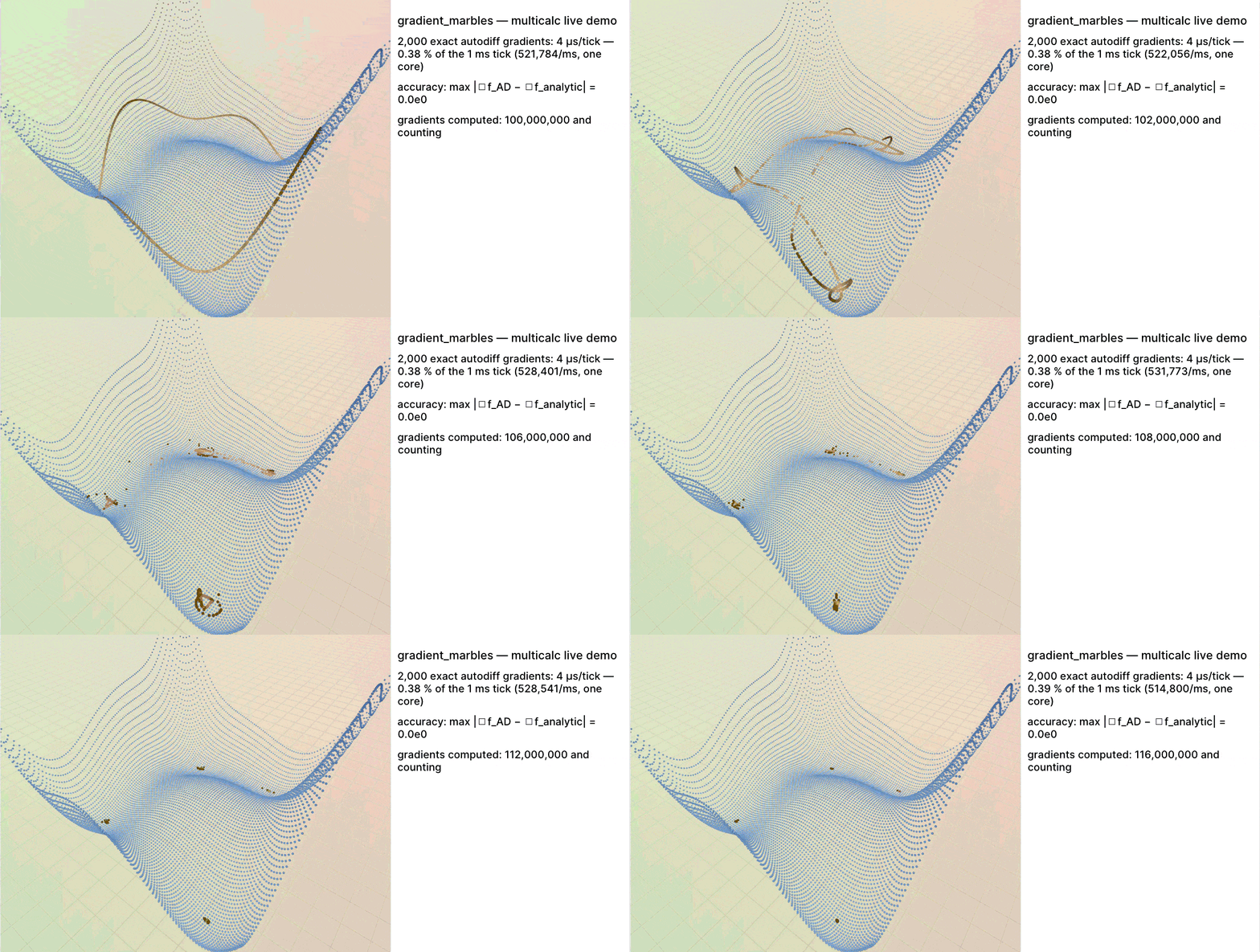
The same formula runs at f64 and at a dual number. No step size, no truncation error.
let f = scalar_fn!(|x| x * x * x - constant(2.0) * x);    // x³ − 2x

let slope = derivative(&f, 2.0);                          // 10, exact
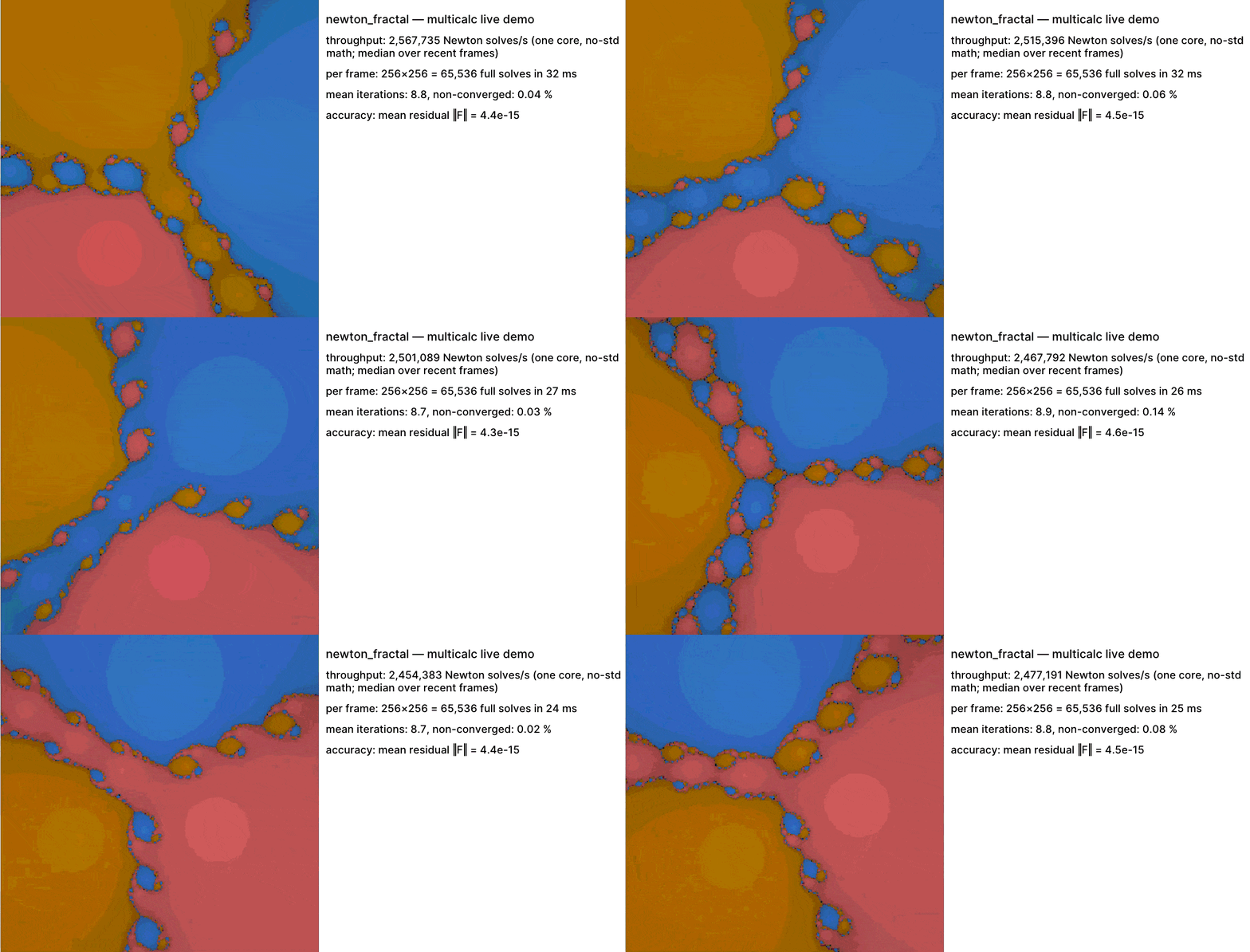
let root  = Newton::new().solve(&f, 2.0)?.root;           // √2
let area  = integral(&|x: f64| f.eval(x), [0.0, 2.0])?;   // 0

let mut filter = KalmanFilter::new(state, covariance, model);
filter.predict();
filter.update(measurement)?;                              // 36 ns, no heap
Community